|




Round link chains hardened
The greater the hardening depth of the round link chain, the higher the abrasion resistance
Depending on the application, one can choose a round link chain in a certain size, but then with a higher breaking load or an increased resistance to wear and tear. One can choose from various materials or from one of many curing methods. Of course, a combination of both can be created. The hardening depth of the wire in the hinges is important. The greater the hardening depth, the higher the abrasion resistance. However, a higher hardening depth can lead to a lower breaking load. Generally, the rule is that the hardening depth can be up to 14% of the wire diameter.
Round link chains fastening elements
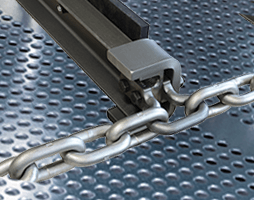
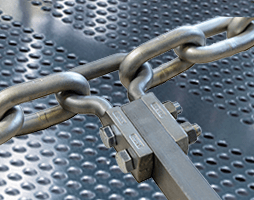
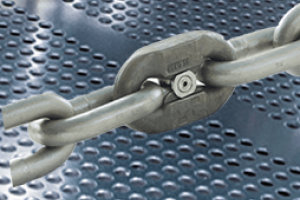
Round link chains are coupled using connecting links or with chain shackles.
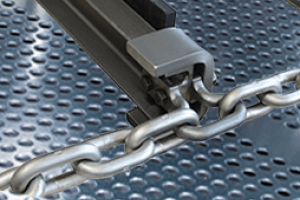
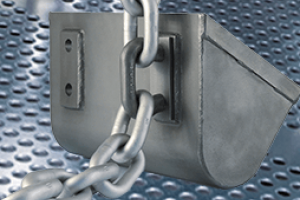
These connectors are available in various designs and qualities. Often customers choose a combination of a connecting element and a scraper which can be attached right onto the element. If chain shekels are chosen, then the elevator buckets can be mounted onto them.
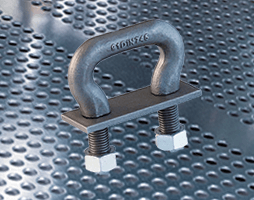
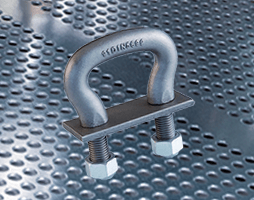
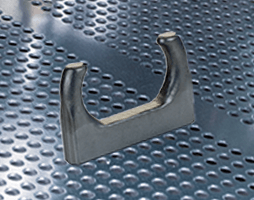
Technical product information:

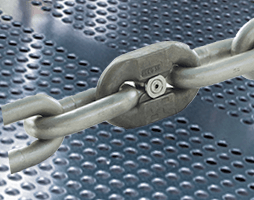
Round link chains stainless steel
Stainless steel round link chains are often prescribed in a moist environments and where corrosion is undesirable
K&W Transmissies offers round link chains in stainless steel, in various quality (SS304 and 316) and price segments. We offer standard chains according to DIN 766, as well as special varieties. Moreover, elevator buckets or welded-on attachments can be supplied. The pocket wheels or drive wheels are manufactured with internal or external teeth in various designs. Stainless steel chains are often prescribed in a moist environments and where corrosion is undesirable, such as, for example, in the food industry. Round link chains are also commonly used in chemical and general machinery industries.
Technical product information:
Round link chains zinc-plated
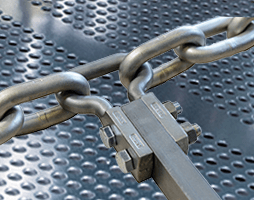
Round link chains are often offered in a zinc-plated design.
This can prevent premature corrosion, but it can also be applied for a certain desired aesthetic effect.
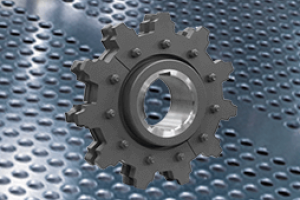
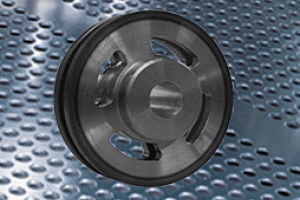
K&W Transmissies is the exclusive representative in the Netherlands of the round link chains made by German brand HEKO. Round link chains are available with various connectors, elevator buckets, pocket wheels, reversing wheels and other customer-specific sprockets, internally or externally toothed. Make your choice below.
IS YOUR CHAINS
NOT LISTED HERE? CALL US!
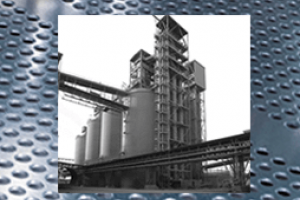
Round link chains, applications
Round link conveyor systems focus specifically on material handling and purification. The customers of K&W Transmissies come from different sectors such as companies in the cement industry, coal-fired power plants, paper, compost, food, chemical and general machinery industries.
Production of round link chains
The steel for the round link chains is procured from steel factories, which must meet very high quality and strength requirements. The material for the link is cut to measure by a cutting tool. Along a bending form, the material is bent in two movements into the form of a link and at the same time pressed together.The welding together of the links takes place without the addition of extra material. The side of the weld is given an electric shock, so that this is heated locally. Immediately after that the ends are mechanically pressed into one another and the steel is welded together.After the welding, the chain class is stamped into the chain and the chain is calibrated. During calibration, the chain is pulled to its exact correct length with a force that is 2.5 times the nominal load of the chain. The deformation and the force required are carefully monitored. Thus, in this manner literally every link of a calibrated chain will also be load tested before delivery.
Diverse models of round link chains
Round link chains are, depending on the application, available in various quality and price segments. There are standard round link chains available in accordance with DIN 764/DIN 766, as well as zinc-plated and stainless steel chains, but also special models with a certificate.NEWS
-
01 Mar 2025
-
02 Feb 2025
-
03 Jan 2025
-
11 Jul 2024
-
02 Jun 2024
-
26 Mar 2023
Careers
QUOTES
Address
K&W Transmissies B.V.
Poseidonweg 31
8239 DK Lelystad
The Netherlands
T +31 320 247370
This email address is being protected from spambots. You need JavaScript enabled to view it.
2nd location:
Apolloweg 104
8239 DA Lelystad
Follow us: